




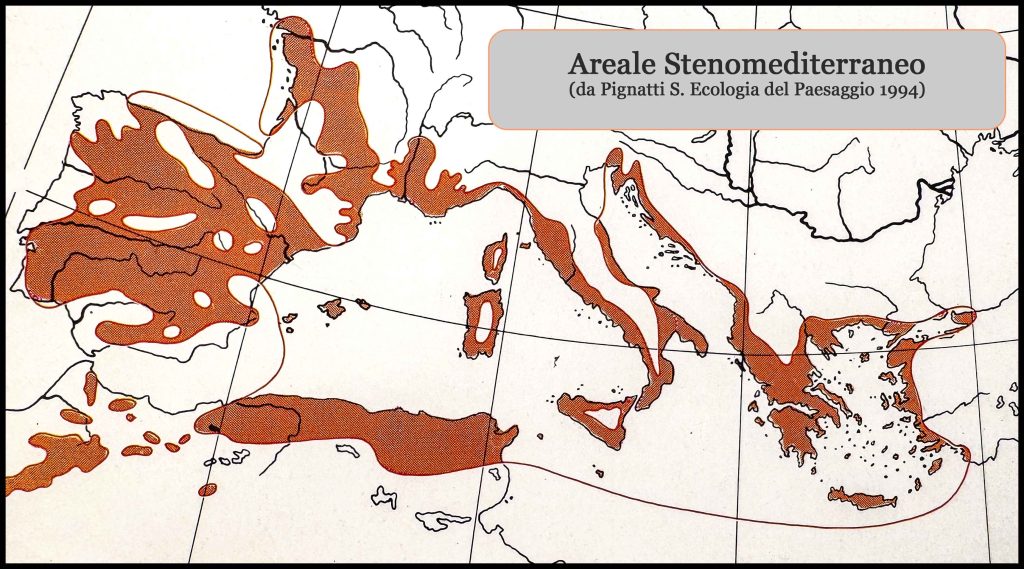
Cosmopolitan plants (couch grass, some nettles, etc.) are found all over the world, while other plants have their own area of origin, their own range. The DISTRIBUTIONAL RANGE is the geographical territory in which a plant grows spontaneously. Different distributional ranges have been given names.* To say, for example, that a plant has a “steno-Mediterranean” distributional range means that this plant is typical of the Mediterranean; a plant with a euri-Mediterranean distributional range is found in the Mediterranean but also in the neighbouring areas to the north and east.
 Of the 33 plants featured in the Orti di Mare ‘Sea Gardens’ path, 29 are from the Mediterranean area (17 are strictly Mediterranean, 12 are also found in other areas), 3 are European and one is exotic. Walking our trail means getting to know most of the trees typical of the Mediterranean climate and, in particular, of the island of Elba.
MEDITERRANEAN (strictly)
Most of the plants (17) encountered along the route are typical of the Steno-Mediterranean area, i.e. they are plants that grow spontaneously strictly in the Mediterranean area. This is the typical area of the olive tree.
- Mediterranean buckthorn – Rhamnus alaternus L. subsp. Alaternus
- Bay laurel – Laurus nobilis L.
- Mediterranean honeysuckle – Lonicera implexa Aiton subsp. implexa
- Sage-leaved Rock Rose – Cistus salviifolius L.
- Hairy Broom (Cistus creticus L. subsp. eriocephalus (Viv.) Greuter & Burdet)
- Strawberry Tree – Arbutus unedo L.
- Narrow-leaved phillyrea – Phillyrea angustifolia L.
- Spanish lavender – Lavandula stoechas L. subsp. stoechas
- Holm oak – Quercus ilex L.
- Myrtle – Myrtus communis L.
- Wild olive Tree – Olea europaea var. sylvestris
- Aleppo Pine – Pinus halepensis Mill.
- Rosemary – Salvia rosmarinus Spenn.
- Spiny Broom – Cytisus spinosus (L.) Lam.
- Cork oak – Quercus suber L.
- Mauritanian Grass – Ampelodesmos mauritanicus (Poir.) T.Durand & Schinz
- Laurustinus – Viburnum tinus L. subsp. tinus
EXTENDED MEDITERRANEAN
The five plants in this group (Euri-Mediterranean) are mainly found along the Mediterranean coast, but their range can extend into the neighbouring areas to the north and east, i.e. the typical vine-growing area.
- Spanish Broom – Spartium junceum L.
- Italian stone pine – Pinus pinea L.
- European nettle tree – Celtis australis L. subsp. australis
- Italian cypress – Cupressus sempervirens L.
- Manna ash – Fraxinus ornus L. subsp. ornus
The MEDITERRANEAN AND MACARONESIA
These three plants are typical of the Mediterranean coastline and Macaronesia, the island system comprising Madeira, the Azores, the Canary Islands and Cape Verde.
- Montpellier cistus – Cistus monspeliensis L.
- French broom – Genista monspessulana (L.) L.A.S.Johnson
- Lentisk – Pistacia lentiscus L.
The MEDITERRANEAN AND OTHER AREAS
This group includes plants found on the Mediterranean coast but also on the Atlantic coast (Erica and Oleander), in southern Europe (Helichrysum) and in western Europe and further west (Ivy).
- European Ivy – Hedera helix L. subsp. helix
- Italian strawflower – Helichrysum italicum (Roth) G.Don
- Tree heath – Erica arborea L.
- Oleander – Nerium oleander L. subsp. oleander
EUROPE AND OTHER AREAS
The range of these three plants covers Europe but extends to Asia and North Africa (hawthorn), the Black Sea area (downy oak) and Western Asia (Judas tree).
- Hawthorn – Crataegus monogyna Jacq.
- Downy oak – Quercus pubescens Willd. subsp. pubescens
- Judas tree – Cercis siliquastrum L. subsp. siliquastrum
NATURALISED EXOTIC
Finally, there is a plant that is native to tropical America and is therefore non-native, brought by humans outside its historical range. This plant is practically naturalised on the Island of Elba without affecting, for now, the island’s biodiversity and, for this reason, is not classified by us as invasive.
- Indian fig opuntia – Opuntia ficus-indica (L.) Mill.
* To define the distributional ranges, chorotypes are used, which are territorial categories created within phytogeography for the purpose of studying a series of characteristics. For example, the Steno-Mediterranean chorotype includes only the Mediterranean area, while the Euromediterranean chorotype includes the Mediterranean coasts with extensions to the north and east.